
By David Leslie Pearce, Commercial Director
Born and raised in Birmingham, England, I first came to Colombia in 2008. Having studied Spanish at Portsmouth University, with a further two years in Granada, Spain, I was already pretty fluent when I arrived in Cali, which helped enormously. That, together with the friendliness of the Colombian people, made me feel very much at home in no time.
With my background in export sales, across a wide range of industries, I was looking for the opportunity to apply my skills and experience here in Colombia and across the Latin American region.
A coffee lover for many years, and with a keen desire to learn and collaborate with the growers in any way I could, my involvement in the sector came about as a result of regular visits to a farm owned by a friend’s family. Mid-way between Riosucio and Quinchía, it sits in the heart of the country’s Coffee Axis, which spans the regions of Caldas, Quindío, and Risaralda.
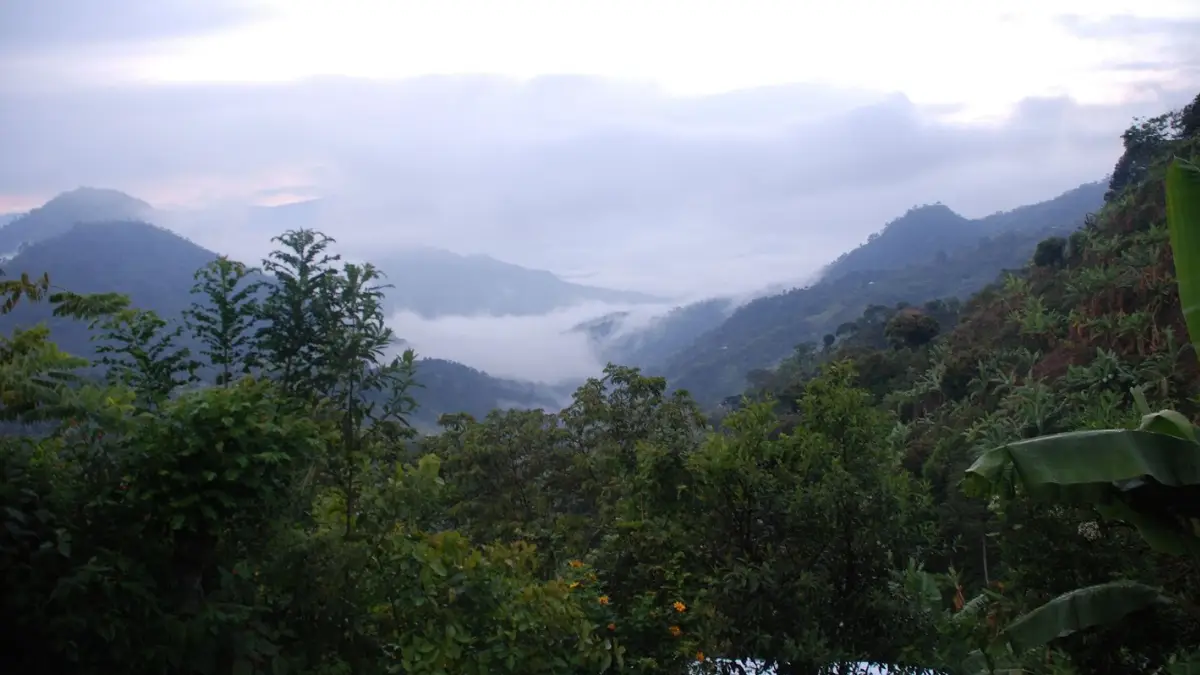
In those early days, I was working in the textile business, spending much of my time in Medellín, the centre of Colombia´s fashion industry, which was where I first met Yuli Andrea. We quickly became friends, and I did not hesitate in taking up her invitation to visit her family´s small 4-hectare farm, the typical size of coffee farms in that area, and, as is often the case, halfway up the side of a very steep mountain! (see photos!!)
Very soon I was taking the 5-hour bus ride from Cali to Riosucio every other weekend, as my regular break from the city. I began to help out on the farm, harvesting the ripe cherries twice a year, extracting the beans from the outer pulp, before washing and drying them in the sun. The dried beans would then be taken by jeep to the local co-operative in Quinchía to be sold. The work intense and seemingly never-ending.
When not harvesting, we would be planting new shoots, which, thanks to the climate and the soil, would soon grow into impressive and productive coffee bushes.
What really caught my attention was the ridiculously low price that they were paid for their coffee, taking into account the long days of hard work, and the myriad costs they incurred during production.
I learned that the price they were paid was set by the stock market in New York, and, from that moment on, my goal was to find a way around that to give them a price worthy of their work and dedication. Goodness knows why the Colombian Coffee Federation continues to be guided by a price set in another country, where they have no understanding of, and certainly no interest in, the amount of work and the financial investment required to produce every kilo of sun-dried coffee beans.
Also, as so very typical of many small coffee farms up and down the country, the head of the household was her mother, widowed during the armed conflict in Colombia. Her husband, Yuli’s father, together with his two brothers, were murdered in the late 90’s by the paramilitaries – forces set up by the government of the time, supposedly to protect the nation from the FARC and other dissident groups. But, these barbaric forces proved to be an even bigger threat to the population, particularly in rural areas, confiscating land and property by force. They were, moreover, responsible for killings, disappearances, and all manner of abuse.
If that was not enough, a few years later, their grandfather was murdered by the FARC. The area in which their farm is located, centred on Quinchía, was very much a ‘red zone’ during that period, characterised by intensive fighting between the Colombian army and the guerrillas.
Bear in mind that this was the story of just one family; the scale of atrocities during the conflict was immense.
These experiences piqued my interest in helping such communities, my desire to ensure fair prices and to generate employment by roasting and packing at origin as opposed to simply exporting the green coffee beans as a cheap commodity to faraway shores, where the value is added by others – be it in Miami, London, New York, Paris, Milan, or wherever – with no attendant benefit to the growers, or the Colombian economy.
Roasting and packing at origin is something carried out far too infrequently in Colombia, where more than 93% of all the coffee exported is shipped in its green state, and similarly in all the world’s coffee-growing countries. The Brewchange Group, via its Edge coffee brand, seeks to balance this state of affairs by roasting and packing at origin, wherever our coffees are grown – thus contributing, step by step, to the local and regional economies and encouraging further technological development. Not only that, but roasting the coffee in that brief window of opportunity – during the 4 weeks following harvest – enhances freshness and aroma in a way that is not possible with coffees that are roasted months, if not years after reaching their export destination.

One Response
Hi, this is a comment.
To get started with moderating, editing, and deleting comments, please visit the Comments screen in the dashboard.
Commenter avatars come from Gravatar.